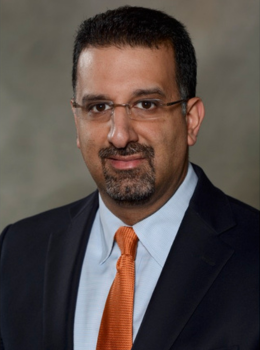
Nitin Seam, MD
Dr. Nitin Seam is a Professor of Medicine at the University of Maryland School of Medicine and a nationally recognized leader in pulmonary, critical care, and medical education research. His work focuses on mechanical ventilation, Acute Respiratory Distress Syndrome (ARDS), and improving how critical care skills are taught and sustained.
He directs the multi-center Critical Care Education Research Consortium, where his research has shown that structured, longitudinal, and simulation-based education—including web-based platforms and artificial intelligence—significantly improves knowledge retention and clinical skills among physicians and respiratory therapists.
Dr. Seam has also led translational research in ARDS and sepsis and served on the NIH COVID-19 Clinical Practice Guidelines Panel during the pandemic. From 2019–2025, he was Editor-in-Chief of ATS Scholar and is a Fellow of the American College of Physicians and the American Thoracic Society. His work has been recognized with the NIH Director’s Award and multiple Teacher of the Year honors.
In this episode of CLIMEcast, CLIME Associate Director Kate Mulligan speaks with Dr. Nitin Seam, Professor of Medicine at the University of Maryland School of Medicine and a nationally recognized leader in pulmonary critical care and medical education research, on the opportunities and risks of artificial intelligence in medical education.
Drawing on his research and clinical experience, Dr. Seam explores how AI can personalize learning and address knowledge decay — a persistent challenge in medical training, where foundational knowledge gained early in medical school often diminishes significantly by the time trainees reach fellowship. He discusses his work using AI to generate high-quality assessments in complex clinical topics, and the potential for lifelong learning portfolios that adapt to individual learners over time.
The episode also turns a careful eye toward risk. Dr. Seam unpacks the concepts of de-skilling, never-skilling, and mis-skilling, ways AI use can quietly erode or prevent the development of core clinical competencies and raises questions about overreliance, screen time, deep thinking, and the importance of keeping humans in the loop. Together, he and Kate reflect on what it means to be a medical educator in an AI-shaped future, and why studying how we use these tools is just as essential as using them.
Resources from this Episode
You can find and subscribe to CLIMEcasts on most streaming services.